Beginning in January 2026, the campus will launch two new modules in Oracle Enterprise Performance Management (EPM) to support annual budget and workforce planning. The first year using this system is foundational and emphasizes clarity, consistency, and shared understanding of planning assumptions and processes.
What's New for Departments
- Planning Sequence: Workforce planning happens first and drives salary & benefits budgets
- Resource Planning: Departments will identify fully-funded budget plans
- System Driven: Budgets are reviewed within EPM, not offline spreadsheets
- Context Matters: Greater emphasis on explaining assumptions, not just totals
- Transparency: Budgets will be discussed with divisional control points using shared views to reduce rework
Your Role as a Financial Analyst or Manager
Departments are responsible for building and explaining their budgets. You will be asked to:
- Review and confirm workforce roster (positions, FTE, rates)
- Verify funding sources for positions
- Enter and review Salaries & Expenses budgets in the Annual Plan
- Identify known changes, risks, or constraints
- Submit budgets for review with appropriate context
Departments should begin work ahead of time to clean up their UCPath funding and budget distribution page entries in anticipation of the Annual Plan & Workforce Planning launch. The more accurate your data is in UCPath, the easier it will be to work with in these modules.
Timeline
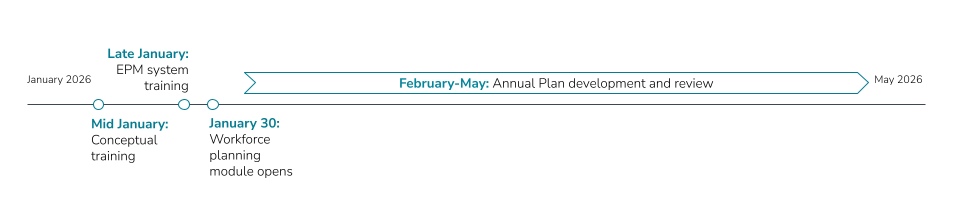
We encourage departments to reference this guide for a comprehensive timeline of the annual planning cycle and activities within each phase.
Support Available
You are not expected to navigate this alone. Support includes:
- Training sessions
- Reference guides
- Office hours by appointment
- Tuesdays from 10am-12pm and Thursdays from 1-3pm
The first year is a learning cycle. Feedback is expected and welcome.
What This Is
A more structured way to plan and explain your budget
A foundation for future improvements
What This is Not
Zero-based budgeting
A test of "perfect" budgets
Frequently Asked Questions
Beginning in January 2026, the campus will use Oracle EPM to support proactive annual budget planning for the 2026-27 fiscal year. This is a new approach for campus and for the Budget Office. While many underlying budget assumptions will remain familiar in the first year, the way budgets are reviewed, discussed, and documented will be more structured and transparent.
Historically, many budget assumptions have been implicit; especially around staffing, funding sources, and the use of balances. Under the new process:
- Workforce costs are reviewed explicitly
- Budget changes are more clearly identified
- Resource gaps are surfaced rather than implied
- Budgets are reviewed using shared, standardized views
The goal is clarity and transparency, not reinvention.
Presently, not fundamentally; but it is becoming more explicit and structured.
The goal is to use a new system to better support existing budgeting practices, while gradually strengthening structure, transparency, and collaboration in the planning process.
The Annual Plan uses a balanced, fully-funded planning approach, meaning:
- Budget will be considered a target or a plan
- Planned expenses must be offset by identified resources (i.e. your Sources budget must equal your Uses budget). Overall, a budget will add to zero within a FRU and Fund.
- If a gap exists, it must be explicitly recorded and explained
- Implicit deficits are no longer acceptable
This does not mean deficits are prohibited; it means they must be visible and reviewed.
The campus has adopted a new financial system with planning tools that can help manage this process. These changes support:
- Better alignment between staffing and budgets
- More consistent review across departments and divisions
- Clearer conversations with leadership and governance groups
- Stronger foundations for long-term financial planning
The first year is intentionally focused on learning and consistency rather than enforcement.
Workforce costs represent the largest and most structural portion of the budget. Starting with workforce planning helps ensure:
- Positions, FTE, and rates are accurate
- Funding sources are understood
- Salary and benefit budgets flow consistently into the Annual Plan
Departments will be asked to:
- Review and confirm their workforce rosters and costing
- Plan Supplies & Expense budgets within a common framework
- Submit budgets for review and discussion through EPM
- Engage in conversations about how their budgets align with resources
For most departments, the experience will feel familiar to staffing with the intent that the system delivers important information:
- You will start with your current base
- You will plan known changes
- You will explain any gaps or risks
What’s different is that these elements will be captured in a shared system and reviewed using a common framework.
Reviewers and approvers (e.g., control points, Deans offices) will have:
- Better visibility into departmental budgets
- Standardized views and rollups
- Clearer points for discussion, endorsement, or follow-up
Training and support will be provided specifically for reviewers, not just data entry users.
Yes. The Budget Office and the Office of Financial Training will provide:
- Conceptual training
- System training
- Reference materials and guides
- Office hours throughout the cycle
This first year is designed as a learning year.
That is expected. The goal is shared understanding and consistency, not perfection. Feedback from this cycle will inform refinements in future years.
Campus has also developed the EPM Transfers module that can be used to modify budgets in-year, and can be used to catch anything that may have been missed during the planning cycle. Unexpected one-time, in-year allocations will also be managed in EPM Transfers.
Yes. This first cycle establishes a foundation. Over time, the campus may choose to introduce more targeted reviews or deeper justification in specific areas, but those decisions would be made deliberately and with campus input.